Showing posts with label Tuesdays Tomes 2011. Show all posts

Tuesday, December 13, 2011

Tuesdays Tomes: The House by the Lock by Mrs. C.N. Williamson

Tuesdays Tomes is a weekly book review of vintage books available free on-line.

The House by the Lock by Alice Muriel Williamson

Do you believe in love at first sight? I have to confess that I sort of do. Three days after meeting my husband, I told my sister that I would marry him-we’re married 33 years and still counting.

Noel Stanton, an adventurer and travel writer, has just returned to England from one of his adventures looking for a taste of home and a bit of quiet. He heads off to the theater and while at the box office meets an acquaintance from his travels in the U.S, Mr. Harvey Farnham of Denver. They sit in adjacent stalls and before the curtain goes up chat.

“Farnham explained to me that he had “run over” to England on business, intending to sell a certain mine of his, which though vastly profitable, was the one thing in which he had lost interest.

‘I’ve had a good offer’, he said; ‘indeed, I’m visiting the house of the man who has made it—a wonderful fellow, only one degree, perhaps, less interesting than you. His name is Carson Wildred.’”

Farnham explained that one of the reasons he came to the theater that night was that Carson Wildred had a previously made engagement to see the performance with some friends and he was extremely curious to see the woman whose beauty Wildred had been praising for days.

“’There’s Wildred and his friends just coming to the stage box. By Jove! what a pretty girl!’

I looked up, because I was sure the volatile American would give me no peace until I had done so; and then, having done so, I completely forgot the play…never I have I looked on a face so radiant, so bewildering.

‘Who is she?’

“A Miss Karine Cunningham.”

And so by page 10, we’ve met all the major characters and already I liked Stanton and Farnham and was suspicious of Carson Wildred to whom Stanton had a visceral and disgusted reaction…he felt he knew him from somewhere but the memory is allusive. And Miss Cunningham? Well, not having fallen in love with her myself at first sight, she’s still a mystery.

I like books that immediately get me into the story and combine romance and mystery. This book has an added allure. Written by a woman and published in 1906, there are many little peeks into what was considered propriety and convention in the relationships between men and women. Sometimes, these comments were so unexpected that they brought me up short.

Read by the always wonderful Roger Melin, you can download this free audio-book here or the free e-book in pdf, ePub or Kindle format here or read it on-line here.ue

Tuesday, December 6, 2011

Tuesdays Tomes: The Fair Reward by Thomas Beer

Tuesdays Tomes is a weekly book review of vintage books available free on-line.

The Fair Reward by Thomas Beer

This 1923 novel gives us a look at the American theater from the end of the 19th century to the 1920s while telling us the story of Mark Walling: actor and producer. Mark is a truly sympathetic character and as we follow his life story, we can’t help but be moved by him…something we wish to shake him and tell him to wake up.

As the novel begins, we are introduced to Mr. John Carlson, producer of an imported play, Nicoline. He’s nervous about the opening. Mr. Fitch tells him not to worry.

“This’ll be a hit. It’s been a hit in London and Paris. The critics-the adapter smiled- won’t dare say anything worse than that it’s immoral. And Cora Boyle will make them laugh in the third act, so that’ll be safe.”

“Boyle? Who’s she? That black headed gal that plays the streetwalker, y’ mean? She’s no good…Common as dirt and no more sense than a turnip.”

And so we meet Cora Boyle. She and Mark Walling are a young married couple when the book opens-it is she that has gotten him into acting and a small part in the play.

Mark and Mr. Carlson eventually become partners in producing plays with quite a bit of success. And Cora…well, I’ll leave that to you to find out when you read this very interesting novel.

A 1922 review in the New York Times just stopped short of calling this novel brilliant. “…it has style and sophistication and personality, intermingled with a truly vivid show of imagination. It even borders on brilliancy…”

Read by Greg W., you can download this free audio-book here or read it on-line here.

Tuesday, November 29, 2011

Tuesdays Tomes: The Young Ladies Cooking Club of Monroe, Michigan Cookbook

Tuesdays Tomes is a weekly book review of vintage books available free on-line.

Cookbook: Young Ladies Cooking Club of Monroe, Michigan

This delightful cookbook was published by the Young Ladies of the Cooking Club of Monroe, Michigan in 1884.

I’ve found that small cookbooks published by organizations or clubs are often very useful precisely because they are not written by professionals. It’s more like having a chat and receiving a recipe from a friend or a friend’s mother or grandmother. This book is exactly like that…but this chat is across more than a hundred years.

What made these young women decide to have a cooking club and then to publish a cookbook

“In launching our little book on the turbulent waters of public opinion, we think some explanation of our audacious undertaking is perhaps necessary, therefore, kind friends, we are going to let you into the secret of its inception with the hope that our frankness may pave the way to a warm reception.”

“It is only fair to say that we started out as a very unassuming little Cooking Club, of only 10 members about two year ago, imbued more with the desire of having a good time together as is the well-known custom of Monroe maidens, than to burden our minds with culinary facts.”

As their membership increased (indeed, they “rose to the dignity of a Constitution”) they began to think about publishing a cookbook and dreaming of what they might do with the proceeds--a trip to Europe being everyone’s favorite idea. (I really like these girls!)

What they do at the Club

“Pray, what do they do at the club?”

T’is ever the question they ask;

But to answer it fully, I fear,

Were rather a serious task;

And yet, if you’ll listen to me,

And pardon my rhyming with “grub”,

I’ll venture a bit of a song

To tell what they do at the club.

The book’s recipes are combined together as menus for entertainments :“Lunch Party” , “High Tea”, “Refreshments for New Year’s Day” includes 3 different menus, “Supper”, “Breakfast”, “Coffee”, “Supper”(2 more menus), “Tea”, “Supper” (6 more times but I really like the first menu in 3 courses: First course-Strawberry Shortcake!. As my son is fond of saying, “Life is uncertain. Eat dessert first.”), “Hallow e’en Party”, “Coffee”, and another “Supper”. The last group of recipes are classed under “Miscellaneous” which includes everything from roast goose to Boston Baked Beans to Lemon Drop Cookies… these just didn’t seem to fit into the categories-you’ll notice there was no “Dinner”. On page 36 there is an index.

Some reflections on the recipes: lots of gelatin in use here (they have a recipe for Coffee Jelly!), lots of canned seafood (well, they are rather far from the ocean!), lots of mayonnaise type salads, and cakes.

Here are a few of the recipes-exactly how they appear in the book.

“VEAL CROQUETTES --Take one veal cutlet, cook and chop very fine, four potatoes boiled and mashed hot, one onion chopped, salt, pepper, butter and a little parsley; mix with the veal adding the juice of one half lemon. Roll in the shape desired, dip in egg and crackers and fry in hot lard.—Miss K. Chapman”

(I never would have thought of adding the lemon juice. And yes, just about everything is fried in lard. I think there was 1 recipe that called for frying in butter.)

“FROZEN PEACHES—One quart of fresh peaches crushed fine and added to one quart of sweet cream all made very sweet; or you can freeze the cream partially and then add the fruit.—Miss Mollie Morton”

(Mmm! And you don’t even have to bother putting this into an ice cream machine.)

You can see in this little cookbook how recipe styles are changing: some of the recipes are given in the “old” way that are common in 19th century cookbooks and some are given in the “modern” way that is more familiar to us though they’re still not quite there. Take a look at these two muffin recipes and you’ll see what I mean. (The italics are mine.)

MUFFINS No. 1—Mix one teaspoon of baking powder and a little salt, into one pint of flour; add to the beaten yolks of two eggs, one tea-cup of sweet milk or cream, a piece of butter (melted) half the size of an egg, the flour with baking powder and salt, and the well beaten whites of two eggs. Beat well, bake immediately in gem pans in a hot oven. -- Miss Hattie Harvey.

MUFFINS No. 2—Half cup of sugar, half a cup of milk, half a cup of water, two and half cups of flour, two heaping teaspoons baking powder, two heaping teaspoons butter. Mix and bake about fifteen minutes. -- Miss Sadie Noble.

You can read this lovely little time-travel cookbook free on-line here. If you would like to look at other vintage cookbooks free on-line, check out this page …there are over 185 cookbooks to look at…have fun!

Tuesday, November 22, 2011

Tuesdays Tomes: The Chestermarke Instinct by J. S. Fletcher

Tuesdays Tomes is a weekly book review of vintage books available free on-line.

The Chestermarke Instinct by J.S. Fletcher

John Horbury, bank manager at Chestermarke’s bank in the small English town of Scarnham, walks out of his house one Saturday evening and disappears. His ward and senior clerk at the same bank, Wallington Neale, cannot imagine where he has gone to and worries that he has had an accident. When Gabriel and Joseph Chestermarke, uncle and nephew and owners of the bank. declare that securities are missing, Neale refuses to believe that Mr. Horbury took them and fled. When Lord Ellersdeane arrives at the bank and asks the owners to please give him his wife’s jewels that he had left with Mr. Horbury, they insist that not only are there no jewels but that they know nothing about any jewels being deposited for safekeeping with the bank and since Lord Ellersdeane is not a regular customer of the bank, the bank is not responsible. When he gave the jewels to Mr. Horbury, it was a personal transaction with Mr. Horbury, friend and not with Mr. Horbury, Bank Manager.

Neale and even Lord Ellersdeane do not believe that Mr. Horbury took the jewels as well as the securites and fled. Only the bankers do.

When lovely, independent Miss Fosdyke, Mr. Horbury’s niece arrives as she and her uncle were to begin their vacation trip together and discovers her uncle is missing, she has no patience with her uncle’s employers. If they don’t want to call in the police “just yet” as they are more worried about a possible run on the bank when word gets around that the Bank Manager is missing, well she does. She too does not believe any rubbish about stolen securities and is simply worried about her uncle.

This is a rousing good mystery with lots of questions, a few clues, a tinker, a moor to roam around in, a Scotland Yard detective and a bit of romance. And best of all, it was kind of fun to read a book in which the bankers are clearly somehow off. I’m not going to give anything away but believe me when I say that every character in the book is sympathetic except the bankers!

Charmingly read by MaryAnn (at one point, you can hear her children in the background :), you can download this free audio-book here or the free e-book in pdf, ePub or Kindle format here.

Tuesday, November 15, 2011

Tuesdays Tomes: A Gothic Romance: The Thing From the Lake by Eleanor M. Ingram

Tuesdays Tomes is a weekly book review of vintage books available free on-line.

The Thing from the Lake by Eleanor M. Ingram

“The Thing from the Lake”-does the title make you think of a 1950’s Roger Corman film? It did me but in truth this delightful 1921 story is more romance than horror.

Roger Locke, a New York composer of popular music and Broadway shows, decides he needs a country house as it is too hot in New York to work during the summer.

“There, Mr. Locke, is a bargain,” the agent called back to me, where I sat in my car.

I nodded, surveying the house with an eagerness of interest that surprised myself. A box-like fairly large structure of commonplace New England ugliness, it coaxed my liking as had no other place I had ever seen; it wooed me like a determined woman.”

He of course buys the house…indeed, he decides that he wants to sleep in it that very night -a bit of “camping out” in the partially furnished house. He gets a bit of a surprise. He’s suddenly awakened during the night. A woman is in his room-she tells him a tale of magic, witches, death and evil-and slips away as mysteriously as she entered.

Locke leaves the next day for New York, after contacting various workmen to set the house to rights.

His cousin, Phillida, has been called home from college by her parents-to be berated for not doing well in her exams and he has agreed to meet her at her train and travel home with her. When her train is late, he calls her parents and telling a small fib says that her train will arrive too late for the connection and that he will take her out to dinner and home later. When he meets Phillida and sees how downcast she is, he offers to let her choose the restaurant. She surprises him by stating she wants to go to a nightclub with an ice dancing show.

There she really surprises him: she introduces him to her secret husband, Ethan Vere, one of the ice dancers. Roger is shocked but he realizes that Phillida has not fallen for some fly-by-night and that Vere is a serious young man who grew up on a farm in Maine and took to ice dancing as the only way he could make a living after returning from the War and that he loves Phillida deeply. Roger offers them the management of the farm and house in Connecticut so they can finally begin their married life together. What he doesn’t realize is that he has won a valuable friend in Vere.

Soon it is summer and Roger Locke is up at the Connecticut house with Phillida and Ethan. ..and the mysterious woman! Who is she and why does she whisper to him to leave the house.

Bright and sunny by day, mysterious doings and chills by night, this Gothic Romance is very entertaining. I thoroughly enjoyed the last chapter-a chapter with an alternate explanation for all that has happened throughout the book! Eleanor M. Ingram wrote several novels-I’m definitely going to read another and I'll report back.

Wonderfully read by Roger Melin, you can download this free audio-book here or the free e-book in pdf., e-Pub, or Kindle format here.

Tuesday, November 8, 2011

Tuesdays Tomes: The Survivors by Tom Godwin

Tuesdays Tomes is a weekly book review of vintage books available free on-line.

The Survivors by Tom Godwin

A little over 4,000 people, men, women and children, are left on an unknown planet after their ship has been boarded by earth’s enemy, the Gern –and left to die. The first night, about a quarter of them do die-killed by a terribly swift lethal disease and by the wild animals that inhabit the planet. But by the second night, they have defenses in place.

Life is not easy on Ragnarok (a perfect name-it is a bit of a rag of a rock). There is a brutally hot summer and a brutally cold winter but over the years, the “colonists” learn to cope better and better. And they vow to someday get back at the Gern and defeat them.

This tale, while technically science fiction, is actually the story of pioneers who rise to meet the challenges before them and to conquer them. The story covers generations-something I really liked-and while its true that we don’t really get to know many of the characters very deeply, we get the overall flow of families establishing themselves in a former wilderness.

Wonderfully read by Mark Nelson, you can download this free audio-book here or the free e-book in pdf, Kindle, or ePub format here.

Published in 1958 (the photo above is of the dustcover to the hardback edition), this book got a title change to “Space Prison” when the paperback was published in 1960. I thought you’d enjoy seeing the 1960 and 1962 paperback covers.

LOL! Isn't the first paperback cover hilarious! A perfect example of Pulp Fiction style. Two years later, the cover returned more to the hardcover graphic style.

Tuesday, November 1, 2011

Tuesdays Tomes: The Sheridan Road Mystery

Tuesdays Tomes is a weekly book review of vintage books available free on-line.

The Sheridan Road Mystery by Paul and Mabel Thorne

A shot is heard in the night! A man runs out into Sheridan Road, Chicago, in his pajamas looking for a policeman! The police arrive, search and search, but there is no body-only a blood stain on the carpet in an apartment whose tenants have been away for months! Was a murder committed? By whom? And who died? What a mystery!

Don’t worry, there are fearless and clever detectives on the case. Detective Sergeant Dave Morgan and Detective Tierney of the Chicago police with the help of the no longer pajama clad Mr. Marsh get their man in the end. On the way, there are twists and turns as the true identity of various characters is revealed and there’s even a bit of romance. Yes, Mr. Marsh has his eye on the young lady in the apartment across the hall, Miss Atwood.

This fun book was written by the husband and wife team, Paul and Mabel Thorne in 1921. It was their first collaboration-after that they wrote one more mystery together and then Paul wrote several on his own.

Delightfully read by J.M. Smallheer, you can download this free audio-book here or the free e-book in pdf, e-Pub, or Kindle format here.

Tuesday, October 18, 2011

Tuesdays Tomes: The Calico Cat by Charles Miner Thompson

Tuesdays Tomes is a weekly book review of vintage books available free on-line.

The Calico Cat by Charles Miner Thompson

Mr. Peaslee and his wife moved into town from their farm one year ago and ever since he has been tormented by a rascally calico cat who likes his hen house. He’s convinced that this calico cat is the smartest, most annoying cat ever: a cat that delights in making him miserable.

When he’s full of his good news-he’s been called to serve on the county Grand Jury and pictures himself serving with wisdom and great dignity, he sees that calico cat sitting on the fence. He’s certain that cat is mocking him and he goes a little crazy. He tries to shoot it!

Now don’t worry, the cat is fine but the ramifications of that shot go far.

This hilarious, generous hearted tale of a small American village on the Canadian border is filled with wonderful characters.

A first novel (1908) by Charles Miner Thompson with illustrations by F.R. Gruger, this story first appeared in The Youth’s Companion, a family magazine (1827-1929). BTW, Francis Bellamy who wrote the Pledge of Allegiance in1892 (it was adopted by Congress in 1942) was a staff writer at The Youth’s Companion.

Charmingly read by Allyson Hester, you can download this free audio-book here or the free e-book in pdf., e-Pub or Kindle format here.

Tuesday, October 11, 2011

Tuesdays Tomes: The Shadow of the Rope by E.W. Hornung

Tuesdays Tomes is a weekly review of vintage books available free on-line.
(Sorry for missing the past two weeks but I just didn't have any time to read while we were away...too busy sightseeing! :)

The Shadow of the Rope by E.W. Hornung

Romance? Mystery? While its hard for me to assign this book a genre, it is easy for me for say how delightful it is.

Young Rachel, alone in the world, jumps at the opportunity to travel from Australia to England as a lady’s companion. On the long crossing, she meets Alexander Minchin. They marry as soon as the boat docks. At first, things go well but soon Mr. Minchin begins to drink heavily and to gamble more heavily. They fight. She finally determines to leave him and having packed her trunk, goes out looking for a hansom cab. On returning, she is shocked to find the police in her home. Mr. Minchin is dead-shot- and she is accused of the crime!

Acquitted of the murder by the jury but not by public opinion, Rachel finds herself penniless and alone. White-haired Mr. Steel, who sat everyday at her trial, offers his assistance. She is hesitant- why would this man, a perfect stranger, want to help her? She has heard of other women, acquitted of horrible crimes, that are later besieged by marriage offers…is this his intention?

She accepts his help because she truly has no other choice, and because he clearly states that she will have her own rooms at a respectable hotel. The next morning he does propose marriage-a completely platonic one. His explanation of why wants to marry her is one of the delights of this book.

I want a wife; or rather, my neighbors seem bent upon finding me one; and, if the worst has to come to the worst, I prefer to choose for myself. Matrimony, however, is about the very last state of life that I desire, and I take it to be the same with you. Therefore--to put the cart before the horse--you would suit me ideally. One's own life would be unaltered, but the Delverton mothers would cease from troubling, and at the head of my establishment there would be a lady of whom I should be most justly proud.

Take that, Mrs. Bennet!

What should Rachel do? Considering her last hasty marriage, you would think she would give Mr. Steel’s offer a pass but she is truly friendless. They marry and after a tour of Europe, they return to his large estate in Yorkshire. She lives in fear of anyone realizing who she is-her innocence and acquittal seem scant protection from the notoriety-and she lives filled with curiosity about Mr. Steel’s never referred to past.

The Yorkshire characters are truly wonderful. We first meet them in Chapter 9-now a favorite of mine: kindly Reverend Hugh Woodgate , his young wife Morna and the incomparable Mrs. Venables (who thought Mr. Steel barely 45 when she wanted him for one of her daughters but now thinks him 65 at the very least). Another interesting and important character is Charles Langholm, a fiction writer.

The novels of Charles Langholm were chiefly remarkable for their intricate plots, and for the hope of better things that breathed through the cheap sensation of the best of them.”

I had to wonder if the author was thinking of himself but my favorite comment is yet to come.

"What!" he cried; "you call yourself a lady, and you don't look at the end before you reach it?"

Ahh, from now on, I will not feel guilty when I peek at the end of a book.

That’s it for now…you’ll have to read this 1902 novel to find out more about Rachel and Mr. Steel. This is the second novel by E.W. Hornung (brother-in-law of Sir Arthur Conan Doyle) that I’ve read and I liked it even more than the first. (You can read that review here.)

Read by Christine DuFour, you can download this free audio-book here or the free e-book in pdf., e-pub., or Kindle format here.

Some rather cheesy yet romantic illustrations


Tuesday, September 20, 2011

Tuesdays Tomes: Raffles: The Amateur Cracksman by E.W. Hornung

Tuesdays Tomes is a weekly book review of vintage books available free on-line.

The Amateur Cracksman by E.W. Hornung

The amateur cracksman is A.J. Raffles…perhaps you’ve heard of him? He’s rather the antithesis of Sherlock Holmes: Raffles is the gentleman thief. (His connection with Sherlock Holmes is really quite close-E.W. Hornung was the brother-in-law of Sir Arthur Conan Doyle.)

Published in 1899, these are the first tales of the adventures of Raffles and his school friend and assistant, Bunny Manders. They simply are gentlemen without adequate means to support themselves who resort to burglary to make ends meet. Bunny has run through his inheritance and Raffles is a well known cricket player but as a gentleman he’s, of course, an amateur player. They take only enough for their needs although Raffles does dream of the “big haul” which will allow him to retire in comfort. Bunny is never very sure about burglary at all.

I enjoyed this series of short stories-each chapter is a separate tale. I suggest skipping Chapter 2-racist comments abound. The only real point of the story is to show that Raffles will never leave Bunny in the lurch.

Many Raffles movies have been made over the years. Most of them have little relationship to the actual tales except for the 1976 British Yorkshire Television mini-series, “Raffles”. (The 1940 “Raffles” starring David Niven is however charming!)

Beautifully read by Kristin Hughes, you can download this free audio-book here or the free e-book in pdf., e-Pub, or Kindle format here.

I thought you might like this: the author “reading” the opening of The Amateur Cracksman. Clever, isn’t it?


Tuesday, September 13, 2011

Tuesdays Tomes: What Katy Did At School by Susan Coolidge + covers over the years

Tuesdays Tomes is a weekly book review of vintage books available free on-line.

What Katy Did At School by Susan Coolidge

(This cover is from 1966...more covers below :)

This delightful 1872 novel for young adults (girls really) is the second book in the adventures of Katy Carr.

The first, called What Katy Did, is I think the earliest example of the later oft used plot device of a young girl falling and becoming bedridden with a back injury. How many later books used that same device? (Pollyanna,(1913) of course, but lots more.) These poor girls did something they were told not to but ended up better people for their trials-more obedient too! It makes me wonder how many boys fell out of trees and ended up bedridden for months or even years, never sure they would walk again.

This story is quite different. What Katy Did at School begins in a most unusual way-it is taken for granted that we have read the first book. I was a bit at sea at first as to who was who. Dr. Philip Carr (Papa) is widowed with 6 children: Katy, Clover, Elsie, Dorry, Joanna called Johnnie, and Phil. (It took me a while to realize Johnnie was a girl! :)

By chapter 2 we’re well on our way into the heart of the tale-Katy and Clover are going off to boarding school for one year. It takes them 3 days of traveling to get from Ohio to their New England school. While we don’t hear too much about their actual studies, this book gives an interesting peak at educational attitudes in the mid 19th century.

I thoroughly enjoyed meeting the girls’ school friends and I especially liked their games and the account of the fads that came and went. We also get some decorating tips!

“They went in. (Room) No. 5 was precisely like (their room) No. 6, in shape, size and furniture; but Rose had unpacked her trunk and decorated the room with odds and ends of all sorts. The table was covered with books and boxes; colored lithographs were pinned on the walls; a huge blue rosette ornamented the head-board of the bed; the blinds were tied together with pink ribbon; over the top of the window was a festoon of hemlock boughs, fresh and spicy. The effect was fantastic, but cheery; and Katy and Clover exclaimed, with one voice, ‘How pretty!’ “

Prettily read by Karen Savage, you can download this free audio-book here or the free e-book in pdf, e-Pub, or Kindle format here.

This book has been quite popular for a very long time. I thought it would be fun to share some of the cover art that has graced this book over the years.LOL! I particularly like the covers that look contemporary to the date of their publication…”Groovy, Katy, groovy!”

1900

1927
1939 (Gotta love that short skirt!)
1949
1968
1975

Tuesday, September 6, 2011

Tuesdays Tomes: The Variable Man by Philip K. Dick

Tuesdays Tomes is a weekly book review of vintage books available free on-line.

The Variable Man by Philip K. Dick

You may not have read many or even any short stories or novels by Philip K. Dick but I’m sure you’re familiar with his work. Blade Runner, Total Recall, Minority Report and this year’s Adjustment Bureau are just some of the films based on his stories.

The Variable Man is a very early story by Philip K. Dick, first published in 1953. (Interestingly, science fiction stories, usually first published in magazines, have entered into the public domain much sooner than other novels.)

The year is 2136 and Terrans are locked into their own solar system by the aging Centaurus Empire. On Earth, life is very well regulated and based on statistical prediction. Terrans are gearing up for a war against the Centaurus Empire-they’re just waiting for the statistical prediction that they will win. Security Commissioner Reinhart keeps a close on the predictions…he’d like nothing better than to give the go ahead for war. Peter Sherikov of Military Design is working on a new, fantastic weapon-one capable of reaching Centaurus faster than light speed but he’s having trouble wiring the control module. (He would love to be able to use the technology for faster than light speed travel rather than as a weapon but the last time it was tried-it exploded-hence the weapon.)

The year is 1913 and Tom Cole, a general traveling fix-it man, is sharpening a knife for the lady in the green house in exchange for a hot meal. Suddenly he and his cart and his two horses are picked up in what he can only call a “tornado”. When he lands-he’s no longer outside-he’s in the middle of a building and people in white coats-lab coats-are all staring at him. (He doesn’t know it yet but a research bubble from 2136 had gone back to 1913 in preparation for the start of WWI and had caught him when it was summarily brought back to 2136.)

Is Tom Cole, general fix-it man, the man to help Terrans break out of the hold of the Centaurus Empire and fill the galaxy or is he the statistical variable that makes prediction impossible?

As usual with Philip K. Dick, his prescience is where the fun really is. Here are two quotes to think about: “Nobody fixes things. When they break you throw them away.” And: “Too much knowledge has piled up in each field. And there are too many fields.”

Wonderfully read by Gregg Margarite, you can download this free audio-book here or the free e-book in pdf. e-Pub or Kindle format here.

Here's the original cover of Space Science Fiction, September 1953 in which "The Variable Man" appeared.


Tuesday, August 30, 2011

Tuesdays Tomes: The Middle of Things by J.S. Fletcher

Tuesdays Tomes is a weekly book review of vintage books available free on-line.

The Middle of Things by J.S. Fletcher

As I read this mystery, my mind kept thinking about that old TV show “Murder She Wrote”-I was sure the mystery writer’s name was Fletcher. In fact her name was Jessica Fletcher or J. Fletcher! Aha! As prolific a writer that Jessica Fletcher was, J.S. Fletcher has her beat. He wrote over 100 detective stories!

In the Middle of Things, Mr. Richard Viner lives with his maiden aunt, Miss Bethia Penkridge in Markendale Square, Bayswater. She likes it when he reads to her of an evening and her favorites are always crime stories.

“What she loved was a story which began with crime and ended with a detection--a story which kept you wondering who did it, how it was done, and when the doing was going to be laid bare to the light of day. Nothing pleased her better than to go to bed with a brain titivated with the mysteries of the last three chapters; nothing gave her such infinite delight as to find, when the final pages were turned, that all her own theories were wrong, and that the real criminal was somebody quite other than the person she had fancied.”

I totally agree with Miss Penkridge-don’t you?

This fun beginning sets up the story quite nicely. After the evening’s reading and once his aunt had gone off to bed, Mr. Viner enjoyed nothing more than a late evening’s walk about the neighborhood. On the night we first meet him, his walk ends with something terrible. He’s quite near home, by a narrow alley, when suddenly a man comes running out! A man he vaguely recognizes! Mr. Viner enters the alley and there, under the single street light, finds the body of his new neighbor-Mr. John Ashton-dead! Stabbed!

Well, the police come and Police Inspector Drillford asks Viner to go with him to break the news of John Ashton’s death to his young ward, Miss Wickham and her companion. Soon a man is arrested but when Viner goes to court for the hearing to testify to finding the body and he sees the accused he realizes that he does know the man: the fellow attended school with him. He’s certain that he can’t be the real murderer and that there must be some mistake and takes it upon himself to find out the truth. (He is totally in the middle of things!) And yes, he-with the help of his aunt and a broken typewriter letter-does!

I thoroughly enjoyed this 1922 mystery and had a good chuckle at the rather contrived romance at the end but as they say, “All’s well that ends well”!

Read by Kehinde, you can download this free audio-book here or the free e-book in pdf., e-pub or Kindle format here.

Tuesday, August 23, 2011

Tuesdays Tomes: The Poor Little Rich Girl by Eleanor Gates

Tuesdays Tomes is a weekly book review of vintage books available free on-line.

The Poor Little Rich Girl by Eleanor Gates

This book was not at all what I was expecting. I knew it had been a Shirley Temple movie and I thought that I remembered that the family loses its money and the poor little rich girl becomes poor. That is not the plot at all! (I now think I mixed it up with another Shirley Temple movie: The Little Princess based on the book by Francis Hodgson Burnett.)

There are actually 2 Poor Little Rich Girl movies: the first starred Mary Pickford and the second Shirley Temple. I love the marketing for the first movie: merging book and movie.

This book is really quite strange.

Little Gwendolyn lives in the nursery. She’s cared for by her nursemaid Jane, her governess Miss Royle and the footman Thomas with a French teacher and music teacher periodically giving her extra lessons. She is sometimes called downstairs to pay a brief visit to her parents in the dining room and to be shown off to their various guests.

Its her seventh birthday and she thinks she’ll now be grown up and she hopes to have dinner with her parents and to go day school. Her fondest memory is of a week spent in the country with her parents where she was allowed to play with a local little boy, Johnnie Blake. They went fishing and he told her that he was all grown up because he was seven.

Frustrated at every turn by Jane, Miss Royle and Thomas and fairly abandoned by her parents (they send a cake up and gifts but don’t even see her on her birthday) she is miserable. She asks Thomas to let her go with him when he walks the dog and he says no and then to quiet her tells that she could be kidnapped! Jane threatens her with “calling the doctor” and “the policeman will come” pretty much whenever Gwendolyn wants to do something other than sit at the window seat and play pretend. When the three hear that she wants to eat dinner with her parents and go to school they watch her even more carefully and as little as she sees her parents they would prefer that she not see them at all so she couldn’t make her requests.

Gwendolyn hears the adults around her and is often confused by the many idioms she hears: ”she’s two faced”, “he’s head over heels”, etc. She constantly asks questions and is constantly rebuffed. (These idioms are rather a theme in this book and it might be fun to actually count them.)

Getting more and more frustrated, Gwendolyn lashes out the only way she can-by crying and tantrums. She’s put to bed where she just cries herself to sleep. The next day, she still doesn’t want to get up and by evening Jane is a bit concerned. She asks Thomas if there is any more of “the quietin’ medicine” but there isn’t. She wants to have the doctor in but Gwendolyn really gets quite hysterical at the very idea (she’s become really quite terrified of the doctor thanks to Jane’s threats) but she agrees that Jane can call him for more medicine.

Now here is where the story gets strange. I’m convinced this medicine is Laudanum-a liquid opium mixture that was very prevalent in the 19th and early 20th century and was given to women and yes, children for nervous complaints. It was even given to infants by their nurses to quiet them.

Jane puts a teaspoonful in a cup for Gwendolyn, gets distracted by the organ grinder outside and goes to the window to shoo him away telling Gwendolyn to drink the medicine. She does-but she puts the spoon in Jane’s coffee cup. Jane, returning to the bed, doesn’t believe Gwendolyn actually drank the medicine and sniffs her coffee cup. Hmm, it smells of the medicine (from the spoon) and despite Gwendolyn’s complaints, gives her another teaspoonful!

Except for the last chapter, the rest of the book is Gwendolyn’s opium induced dream. There’s the organ grinder and Jane, Miss Royle, Thomas, her lost teddy bear, her parents and all those idioms-now explained -with literal meanings. (Some of these are quite enjoyable-one, the King’s English is completely un-understandable!)

Gwendolyn, through her dream, works out to her own satisfaction many of her frustrations and you can just imagine how her illness works on her parents so by the end of the book all is well.

It’s rather hard to believe The Poor Little Rich Girl was meant as a children’s story-it’s more a guide for parents. If any children did read it, I think that they would decide that they didn’t want to be rich!

Perfectly read by Susan Umpleby, you can download the free audio-book here or the free e-book in pdf., e-pub or Kindle format here.

I found the Mary Pickford movie at You-Tube. The first segment is really quite delightful and true to the book. (I peeked at the Shirley Temple movie and immediately I saw it was quite different.) So if you'd like to watch...


Tuesday, August 16, 2011

Tuesdays Tomes: A Woman Who Went to Alaska by May Kellogg Sullivan + photographs

Tuesdays Tomes is a weekly book review of vintage books available free on-line.

A Woman Who Went to Alaska by May Kellogg Sullivan

Mrs. Sullivan’s recollections begin in 1899 with her first trip north to Dawson, Canada by ship and train during the Klondike Gold Rush. She traveled alone, on her way to surprise her father and brother. I couldn’t help but feel a little sorry for her-she was quite shocked by the sometime drunkenness of the passengers. Like many travelers anxious to arrive, she also does not have very nice things to say about Canadian officialdom. She spent the summer in Dawson but really tells us very little about her time there and is soon back on board ship leaving-though this time with her brother.

Something must have clicked for her because the following spring she’s travelling again-this time to Nome with a group of friends. They’re all planning to find work there. Mrs. Sullivan is by now clearly a much more seasoned traveler

For me, the book really got interesting with Chapter 9 when her true tale begins. She finds work as a kitchen help, first at a mining camp and then at a restaurant run by several Swedish women she met on the steamship. These women become her true friends and when winter approaches, she goes with them to winter at a mission on the Golovin Bay where they know the minister. Alma, Mary and the other ladies become truly alive for the reader and Mrs. Sullivan’s adventures in Chinik are very interesting. She often simply quotes from her journal and so gives a day by day account which gives us a feeling for the rhythm of her life there. One funny story which all sewers will enjoy tells of her trying to make a pattern for footed pajamas! I also enjoyed her recital of the meals that they ate and the temperature! (That actually surprised me-I expected a constant 30 below or so but no, there were often wide fluctuations.) She has some of the men prospectors she met at the mission stake some mining claims for her. (No, we don’t hear how these turn out!) She has some rather harrowing adventures too when she moves from the mission to a nearby hotel to be near a sick child she is teaching.

Perfectly read by Karen Commins you can download this free audio-book here or the free e-book in pdf, e-pub or Kindle format here.

You can also read my review of a fiction work on the Nome Gold Rush here. While fiction (and a rousing good story) the author, Rex Beach, was actually in Nome and partook of the Gold Rush.

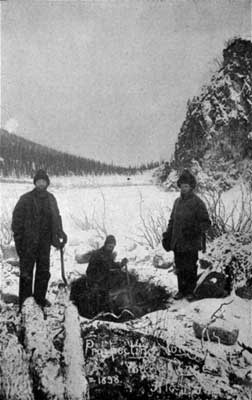
Mrs. Sullivan seems to never have been without her camera and so I’m sharing below some of her-as she called them-Kodaks or you can look at all of the book’s photographs here.

Mrs. Sullivan herself in her Alaskan winter clothes.

The Hannah that we hear about.
Nome and its white tents.
The Mission at Chinik including reindeer!
Prospecting in winter...did her hole bear golden fruit?
From her visit to Bonanza just before she left for home the second time.

Tuesday, August 9, 2011

Tuesdays Tomes: The Dragon's Secret by Augusta Huiell Seaman

Tuesdays Tomes is a weekly book review of vintage books available free on-line.

The Dragon’s Secret by Augusta Huiell Seaman

Leslie Crane and her Aunt Marcia have rented a cottage on the Jersey Shore-not in the summer as most people do but in the early autumn. Aunt Marcia suffers from nerves and her doctor recommended rest and Leslie has come along to keep her aunt company and to generally “keep house”. She’s missing school but isn’t worried-her friends are sending her all the lessons she is missing.

“Oh the ocean is wonderful in October!” she murmured aloud. I never had any idea how wonderful. I never saw it in this month before. Come, Rags!” A black-and-white English sheep-dog, his name corresponding closely to his appearance, came racing up the beach at her call.”

One very wet and stormy night, Leslie, looking out her window at the wondrous weather, sees a light through the cracks of the shutters at the closed house next door. Could someone be in there? Its just for a second but…

The next day she and Rags walk on the beach amidst all the flotsam and jetsam from the storm.

“There was a new and wonderful fascination to her in examining this ancient wreckage, speculating on the contents of unopened tins, and searching ever farther and farther along the shore for a possible treasure-trove of even greater interest or value.

“Why shouldn’t I find a chest of jewels or a barrel full of golden coins or a pocket-book crammed with bills, Rags?”

But instead Leslie finds a treasure of a different sort-a friend. Walking with her head down looking at the sand, she plows right into someone-Phyllis Kelvin, a girl about her age who is at the Shore with her father and brother Ted.

The girls go off walking down the beach, back towards Leslie’s cottage, calling for Rags all the way. They spot him in the yard of the closed cottage next door.

“There’s Rags! He’s after another hermit-crab!” cried Leslie…They both raced up to him and reached him just as he had apparently attained the end of his quest and backed out of the hole.

“Why, what has he got?” exclaimed Phyllis. “That’s no hermit-crab!”

It was a burlap bag and inside was a beautiful carved box: a box carved with a dragon!

And so begins the girls’ adventure. Who did the box belong to? Why and when was it buried under the tree? How did the box open? What did it contain? And who was sneaking around trying to get it? All these questions are eventually answered of course but a ripping good time is had until they’re all answered.

I thoroughly enjoyed this 1921 young adult mystery. If you’re a fan of Nancy Drew type mysteries, I’m sure you’ll enjoy The Dragon’s Secret too.

Read by J.M. Smallheer, you can download this free audio-book here or the free e-book in pdf., epub, Kindle and more formats here.

If you would like to know more about Augusta Huiell Seaman and the collectability of her books, you’ll enjoy reading this article on bookfever.com.


Tuesday, August 2, 2011

Tuesdays Tomes: The Green Rust by Edgar Wallace

Tuesdays Tomes is a weekly book review of vintage books available free on-line.

The Green Rust by Edgar Wallace

Edgar Wallace with about 200 titles to his name is one the most prolific writers ever and he’s the creator of King Kong!

The Green Rust, written in 1919 (one of 3 novels he published that year) begins with a bang-as all good melodramas should.

We meet Mr. John Millinborn, deathly ill and attended by the local Dr. van Heerden, telling his lawyer about Miss Olivia Predeaux, the niece he has never met. He has just left his entire fortune to her and charges Mr. Kitson with finding her and protecting her from unscrupulous men. Mr. Millinborn has added what he thinks is another protection for Olivia-she is not to inherit until she is married.

Before the first chapter is finished, a hobo has been seen lurking around, we have met the main villain and Mr. Millinborn has been murdered in his bed!

Although the action keeps apace, it doesn’t always make the most sense but that hardly seems to matter: the strength of the book is in the wonderful characters. Olivia Cresswell/ Predeaux is delightful and Mr. Beale, the private detective Mr. Kitson has hired to find and protect Olivia is charming. Dr. van Heerden, a German posing as Dutch, is devious, unscrupulous and revengeful. (He has an evil plan to destroy the Allies wheat crop.)

My favorite part: definitely the window scene in chapter 20. Trust me-this scene gives Shakespeare’s Romeo and Juliet a run for the money.

Read by Don W. Jenkins (in a hardy Western voice that made me rather surprised to find that this book takes place in England!) you can download this free audio-book here or the free e-book in pdf. or kindle format here.

Tuesday, July 26, 2011

Tuesdays Tomes: The Money Moon: a Romance by Jeffery Farnol

Tuesdays Tomes is a weekly book review of vintage books available free on-line.

The Money Moon, A Romance by Jeffrey Farnol

This humorous tale of Romance stars:

Mr. George Bellew, An American Millionaire

Miss Anthea Devine, An Independent Woman

Master George, Young Nephew

Sergeant Appleby, A Retired Soldier

Miss Priscilla, Housekeeper

Adam, Farm Hand

Prudence, the Cook

Mr. Cassilis, Local Squire

Ah, have you already guessed the match-ups?

George Bellew’s girlfriend has decided to marry a Duke and he, plagued by the “Haunting Spectre of the “Might Have Been”, decides that a walking tour is just what he needs. Off he goes from London to Kent where he meets first Adam (he falls asleep in Adam’s hay wagon) and then Young George-who takes him home.(The two Georges immediately have a bond-after all, they have both been called Georgy Porgy and accused of kissing the girls!) And there George Bellew meets Ms. Aunty Anthea and decides he’s found Arcadia.

I thoroughly enjoyed this really sweet and rather silly novel from 1911-a perfect summer read.

Jeffrey Farnol, with Georgette Heyer, is credited with beginning the Regency romantic genre: he does quite well in this “modern” romance.

Read by John Lieder, you can download this free audio-book here or the free e-book in pdf. or Kindle format here.

Tuesday, July 19, 2011

Tuesdays Tomes: The Lodger by Marie Belloc Lowndes

Tuesdays Tomes is a weekly book review of vintage books available free on-line.

The Lodger by Marie Adelaide Belloc Lowdes

Mr. and Mrs. Bunting are in desperate straits: they have a boarding house with no boarders. Since their last lodger left, they have quietly pawned many of their lovely things and have even borrowed money from their young friend, the police detective Joe Chandler . Retired from service upon their late in life marriage, Mr. and Mrs. Bunting never thought they would ever face starvation but they are very close now indeed.

Mr. Bunting hears a news crier, “Horrible Murder! Murder at St. Pancras!”…”The Avenger! The Avenger at his work again!” He hasn’t read a paper for days and it was always one of his greatest pleasures. He can’t resist-never mind the cost-he gets up and buys a penny paper.

“He stepped past her heavily, and though she said nothing, he knew she grudged him his coming joy. Then, full of rage with her and contempt for himself, and giving himself the luxury of a mild, a very mild, oath-Ellen had very early made it clear she would have no swearing in her presence-he lit the hall gas full-flare.

‘How can we hope to get lodgers if they can’t even see the card?’ he shouted angrily.”

Sure enough, a little while later there’s a knock on the door…a man looking for lodgings. As Mr. Sleuth settles in, Mrs. Bunting becomes more and more unsettled. The Avenger murders continue and she begins to suspect her lodger.

This 1913 novel is a psychological drama…the question is, is it a psychological drama of a serial killer or of Mrs. Ellen Bunting? I definitely feel that I know much more about Mrs. Bunting and yet have many more questions as to why she acted the way she did than I do about the murderer. We are told about the murders as they are reported in the newspaper: are they connected to the Bunting household in any way or is it all in Ellen’s mind? The suspense builds-I could hardly restrain myself from peeking at the end of the book. (Definitely don’t look!)

This is one of those books that is perfect for a Book Club-I know I could discuss Ellen for hours.

The Lodger has been made into several movies: the first by Alfred Hitchcock in 1927. You can view this silent film free on-line here (and yes the storyline is as usual different from the book).

Perfectly read by LeeAnn Howlett, you can download the free audio-book here or the free e-book in pdf. or kindle format here.